Business2 min
Canada and EU Seal 'Alliance for the Future' With Deals on AI, Minerals
After a two-day Montreal summit, Ottawa and Brussels signed a digital trade pact, a critical minerals financing deal and a Ukraine loan pledge, and here is what each means.
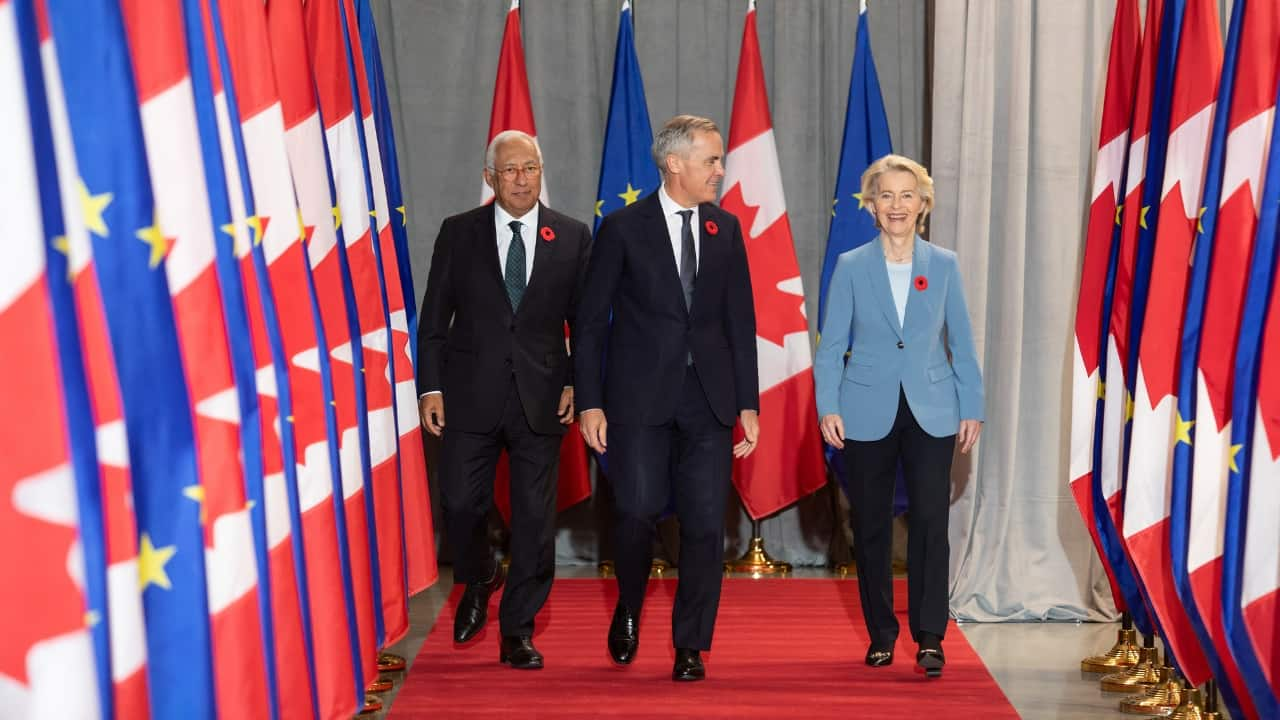
Canada and the European Union have launched a new strategic partnership, announced Friday after a two-day summit in Montreal. The deals cover Ukraine funding, artificial intelligence, digital trade and critical minerals, as both sides look beyond a United States whose policies under President Donald Trump have strained old alliances.
Prime Minister Mark Carney, European Commission President Ursula von der Leyen and European Council President Antonio Costa led the talks. A joint statement named the effort an "Alliance for the Future", meant to build a shared space for prosperity and economic security.
The money. Canada will initially put 500 million euros (about $558 million) into the EU's 90-billion-euro (about $103 billion) support loan for Ukraine. Von der Leyen said the move sends Kyiv a powerful message of solidarity.
The minerals. Canada holds large reserves of rare earths and other critical minerals. Europe wants them to reduce its heavy dependence on China. Under a new arrangement, the European Investment Bank can back mineral projects in Canada, which could help miners raise financing. The source notes the sector will still need major infrastructure investment.
The tech. The two sides signed a digital trade agreement and agreed to work together on satellite connectivity, navigation and AI. The EU has opened its supercomputing infrastructure to Canadian researchers, businesses and start-ups. Ottawa also announced CAN$1.6 billion (about $1.1 billion) for Canadian AI firm Cohere on Thursday. Cohere recently partnered with Germany's Aleph Alpha, which Carney held up as a model for the relationship.
The people angle. Work has begun on Canadian participation in the Erasmus student exchange programme and the Galileo satellite navigation system. If completed, that could widen study and research opportunities.
Carney said the world is "becoming more dangerous and divided" and pointed to the "weaponization of trade". Both Canada and the EU have faced US tariffs and Trump's territorial threats. They already share a free trade agreement. Von der Leyen said Canada cannot join the EU as a full member because of its geography, but Brussels wants it "as close as possible".
Read the original report at Moneycontrol.
FiledArtificial IntelligenceUnited StatesDonald TrumpUkraineClimateRussia